LLM Routing Strategies: The Five That Matter in Production
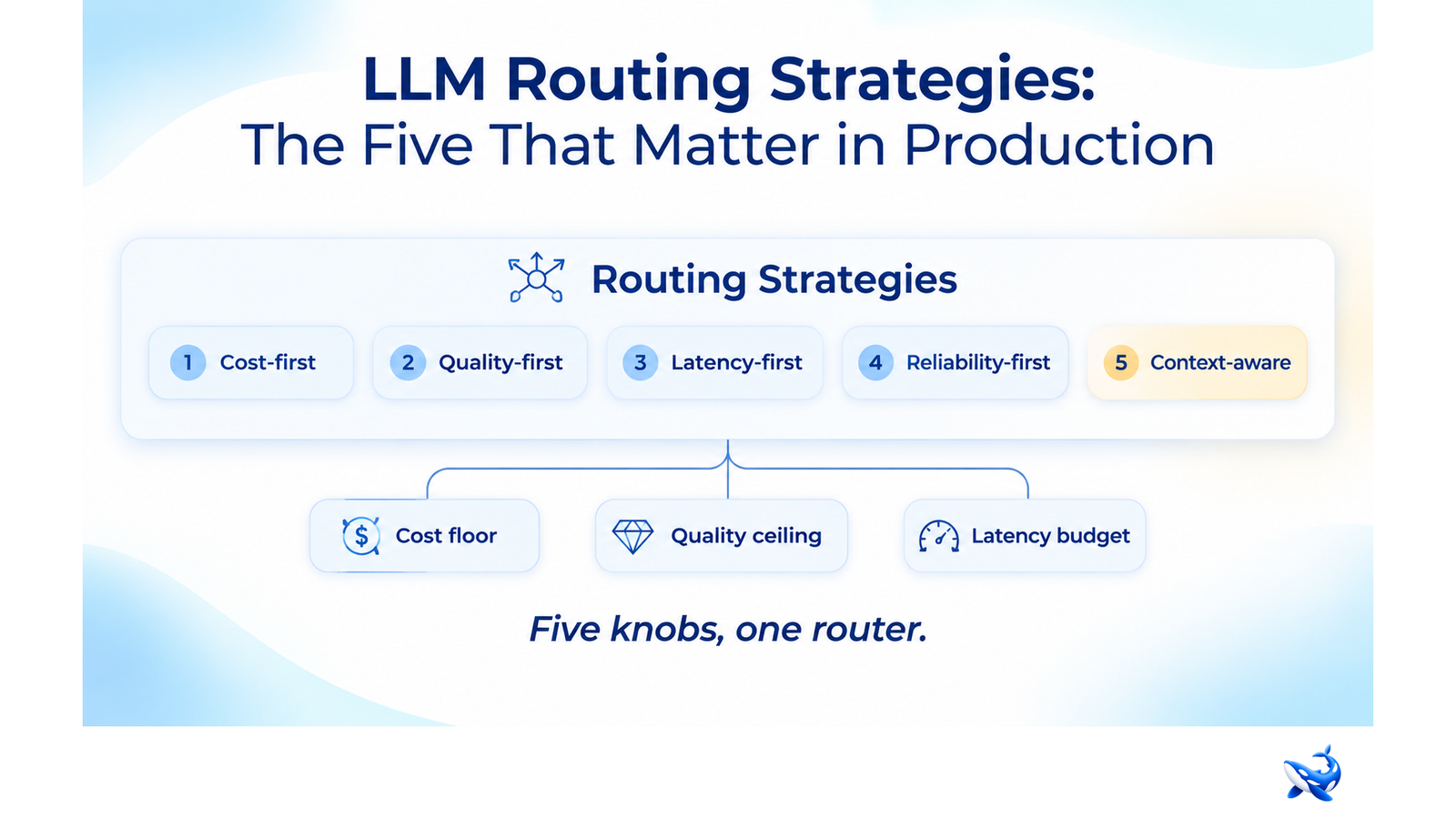
Pick the wrong llm router and your LLM stack becomes an expensive lottery: the cheapest model answers everything and quality quietly decays, or the best model answers everything and the bill explodes. A production router makes this decision per request instead of once at build time, and the spec sheet for GPT-5.6 Terra shows the frontier pricing that makes per-request choices worth automating; the strategies a production router runs fall into five families — cost-first, quality-first, latency-first, reliability-first, and context-aware. This article is the taxonomy: what each strategy optimizes, when it fits, how to combine them, and how a router actually expresses them as rules.
Nobody starts with routing strategies. Most teams start with one model, hit one wall — a price spike, a slow response, a provider outage — and bolt on a second model, then a fallback, then a retry loop. That is how a decision that should be explicit becomes implicit, scattered across code paths and config files, invisible until the bill or the error rate moves. You end up with a system that routes, in the sense that a coin flip decides — but no one can say what it is optimizing for, or why. Naming the strategy is the first step toward controlling it, because a strategy you cannot articulate is a strategy you cannot tune.
The five strategies, and what each optimizes
Cost-first. Route each request to the cheapest model that still clears a minimum quality bar. This is the default for high-volume, low-stakes work: classification, extraction, summarization, bulk rewriting, anything where the marginal dollar is visible and the marginal error is not. The risk is invisible quality decay — the cheap model passes the first thousand cases and fails on the adversarial one, and nobody notices until a customer does.
Quality-first. Route to the best available model regardless of price. Correct for hard problems with a high cost of being wrong: gnarly code, long-horizon agentic work. Analysis where a mistake costs more than a few extra cents of output. The failure mode is the mirror image of cost-first: a budget that looks nothing like a budget. Because a model that produces the right answer on the second try has already paid for itself, while one that hallucinates confidently has not.
Latency-first. Route to the fastest model that meets the latency budget, optimizing time-to-first-token and output speed. This is the strategy for chat and anything a user is waiting on. A slow flagship is a bug, not a feature, when a human is staring at a spinner. The p95 latency of your stack, not the median, is what your most impatient users actually experience.
Reliability-first. Route around failure: when a provider returns 5xx, rate-limits, or degrades, send the request to a healthy alternative. This is failover as strategy, not as emergency. It is the difference between an outage that makes the news and a retry the user never sees and it belongs in the strategy list rather than a post-incident checklist. Because outages are a normal event in a multi-provider stack, not an exception.
Context-aware. Route based on what already happened in the session — the accumulated conversation, the prompt prefix, the warmed cache. A continuing session has different economics than a cold start, and the strategy should know that.
| Strategy | Optimizes | Best when | Weakest when |
| Cost-first | Price per request | High volume, low stakes, budget caps | The adversarial 1% is expensive |
| Quality-first | Output quality | Wrong answers are costly | Cost per request is a hard constraint |
| Latency-first | Time to first token | Chat, interactive agents | Quality requirements are high |
| Reliability-first | Uptime, error rate | Production continuity | It’s optimized alone, without a cost policy |
| Context-aware | Session economics | Agents, long conversations | Sessions are short and stateless |
No single row is “correct.” They are different answers to the same question — what should this particular request cost, in money, latency, and risk?
Combine them: cost floor, quality ceiling, latency budget
The strategies only get interesting when you refuse to pick one. The standard production shape is a cost floor plus a quality ceiling plus a latency budget. The router grades each incoming prompt, rejects models below the quality floor and above the latency budget, and picks the cheapest survivor. That ordering matters the ceiling keeps the fast-and-dumb model from ever seeing a hard request. The floor keeps the expensive flagship from touching trivial ones, and the budget keeps users from waiting on the slow thinker. Each knob protects one of the other strategies from its own weakness. The cost floor keeps cost-first from degrading, the ceiling keeps quality-first from overspending, and the budget keeps latency-first from quietly routing everything to the fastest weak model.
This is precisely how adaptive routing works in practice: each prompt is graded in under 1 ms and then routed to the cheapest model that meets the stated standard [OrcaRouter]. The grade is a cheap, fast filter that runs before any model is called. So the expensive quality check happens inside the router rather than in the wrong model’s output. Two things make that grade practical. First, it has to be fast enough that it never becomes the bottleneck a grading step slower than the models it is choosing between defeats the point. Second, it has to be a real filter, not a formality: if every prompt passes the floor, the “combination” is just quality-first with extra steps, and you are paying flagship prices for trivia.
The economics only hold if the router is not silently adding to the price of every request. A router that marks up every call makes cost-first routing a contradiction — you optimize for the cheap model and pay a premium on all of them, so the savings you tune for are quietly taxed back. A zero-markup model passes provider list prices straight through, which is what makes the cost comparison honest [OrcaRouter]. If you cannot see the provider’s price in your bill, you cannot know whether your strategy is working, or whether you are simply paying a toll on every request in exchange for convenience.
Expressing a strategy as rules
A strategy is not a vibe; it is a set of rules the router can evaluate per request. Concretely, that means: a tiering of models with a quality grade for each, thresholds that decide when a request may drop down or must climb up, a defined fallback order for failures, and budgets that cut a request’s options when spend accumulates. You can think of these rules as the router’s version of a service-level objective — except instead of one threshold for a whole fleet, it is a decision per request, and the decision is cheap enough to make every time.
The difference between a rule and a hope is that a rule is inspectable. Before you go to production, your router should be able to answer a simple question for any given request: which model will handle it, and why. If the answer is “whatever the code path happens to pick,” you do not have a routing strategy, you have an accident. A defined fallback order belongs in the same file as the tiers, because the failure behavior is part of the strategy — a reliability-first strategy with no explicit fallback chain is just a guess with better intentions.
You also need to see what the rules did. Per-request logs turn “our costs are weird” into “requests with prompt prefixes longer than X are being routed to the flagship” — the observable layer is what lets you tune thresholds instead of guessing at them. A routing strategy you cannot audit is a prayer with extra steps.
Context-aware routing is the sleeper
The strategy people underrate is context-aware. A session that has been running for twenty turns carries state — prior answers, a warmed prompt cache, an accumulated context window — and the economics of that session are different from a cold start. Prefix-aware routing uses the shape of the conversation to make the call: a short, fresh prompt might deserve the flagship; a long, continuing session with a warm cache might be fine on a cheaper model that already has the context loaded.
This is why session-aware routing matters more as agentic workloads grow. Agents re-read context constantly; routing that ignores the session pays the flagship rate for cache hits, or worse, bounces a long-running session to a model that has to re-ingest everything from scratch. A router that tracks the session can keep the context warm and the cost per turn low, which is the difference between an agent that is economically viable and one that is a demo.
The tradeoff nobody wants to name
The honest tension is between the two extremes: route everything to the cheapest model, or route everything to the best. Both are strategies, and both are usually wrong. The cheapest-model-only approach quietly trades quality for a spreadsheet that looks great — until one wrong answer costs more than a month of savings. The best-model-only approach is simpler to reason about but makes cost a rounding error of the design, and it is only defensible when your volume is genuinely small. The mistake is treating either extreme as the “safe” option: cheap-everything feels prudent, best-everything feels responsible, and both are really just avoiding the harder work of grading requests.
The middle is uncomfortable because it requires trusting a decision process you cannot fully predict: the router will occasionally route a hard request to a cheap model, or an easy one to an expensive model, and you will have to live with the variance. That is the price of routing at all. What makes it acceptable is measurement — the request logs that show what the router actually did, and budgets that contain the downside while you tune. A few visible misroutes, caught in logs and fixed by tightening a threshold, are a cheap education compared with the silent systematic error of a single-strategy setup that never tells you what it is doing.
One practical note: automatic failover is the component most teams bolt on last and regret missing first. When it is built into the router as part of the reliability-first strategy, the fallback happens without a code change or a pager alert [OrcaRouter]. Routing strategies should make the system quieter, not louder.
The takeaway
Five families cover the decision space: cost-first, quality-first, latency-first, reliability-first, and context-aware. Use them individually for a single dominant constraint — high volume, high stakes, interactive latency, uptime, or long sessions — and combine them when your workload has more than one constraint, which is most production workloads. The combination shape that survives contact with reality is cost floor plus quality ceiling plus latency budget, expressed as auditable rules. The strategies are not for you if your stack is one model and one happy path; they pay for themselves the moment a second model enters the picture, and the decision moves from “which one” to “on what basis.” If you are unsure which strategy fits your traffic, route a mixed workload through a router that grades each prompt, watch the logs for a week, and let your own requests tell you.
Sourcing note: All OrcaRouter facts (per-prompt grading in under 1 ms, routing to the cheapest model meeting the standard, 0% markup pass-through, automatic failover, prefix/session-aware routing, per-request logs) are from OrcaRouter’s homepage, solution pages, and blog, verified August 22, 2026. No third-party benchmark data is cited in this article; tradeoff claims reflect common production patterns rather than vendor-reported figures.